applied for
Peer Review Policy
Journal of Transformative Pedagogies and Learner Engagement, published by Synergy Publication, is committed to maintaining the highest standards of scholarly quality, fairness, transparency, and ethical integrity in academic publishing.
All submitted manuscripts, except editorials, invited commentaries, and book reviews, undergo rigorous peer review in accordance with the ethical guidelines of the Committee on Publication Ethics (COPE) and best practices recommended by the Directory of Open Access Journals (DOAJ).
All manuscripts submitted to the journal are screened for plagiarism using iThenticate plagiarism detection software provided through Crossref before being sent for peer review. The editorial team manually evaluates similarity reports to determine whether any overlap constitutes an acceptable scholarly citation or potential plagiarism.
Type of Peer Review
The Journal of Transformative Pedagogies and Learner Engagement employs a double-blind (double-anonymous) peer review process, whereby:
- The identities of authors are concealed from reviewers.
- The identities of reviewers are concealed from authors.
Reviewer identities remain confidential and are not disclosed to authors or other reviewers unless a reviewer voluntarily chooses to reveal their identity. All reviewers are required to treat manuscripts as confidential documents and must not share or use unpublished material for personal research purposes. This approach minimizes potential bias related to gender, institutional affiliation, nationality, career stage, or reputation, ensuring fair and objective evaluation based solely on scholarly merit.
Peer Review Process
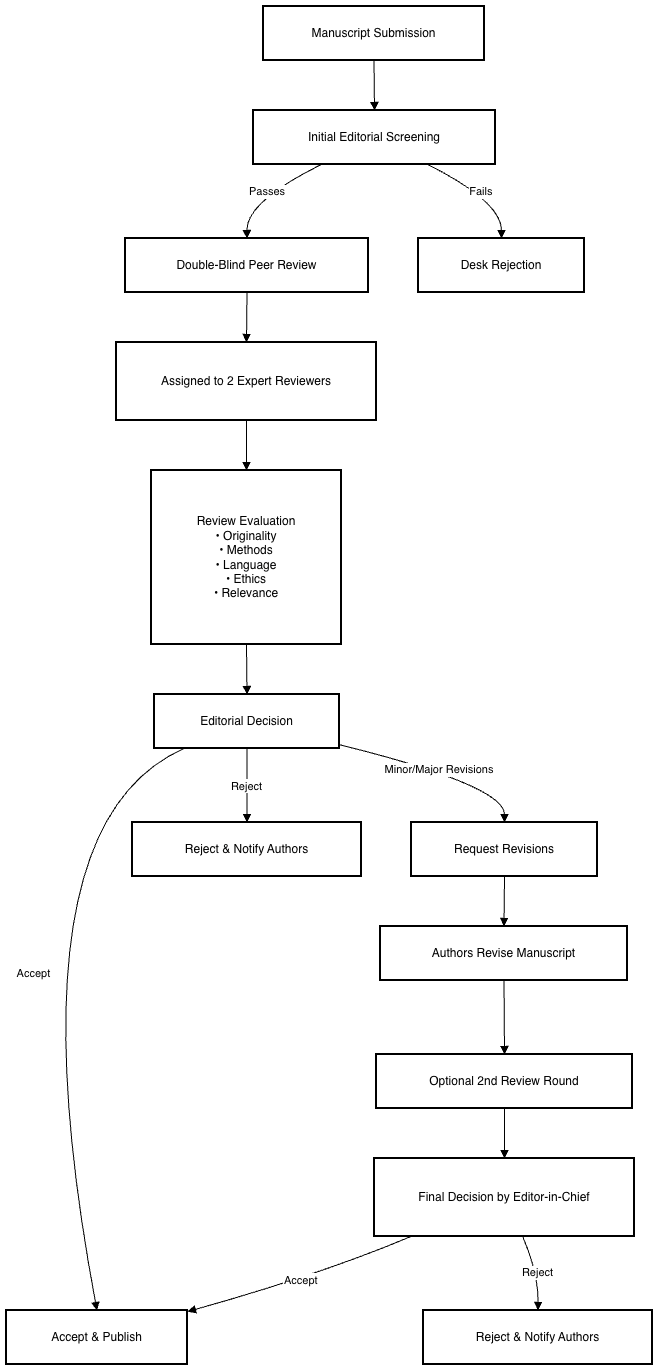
1. Initial Editorial Screening
Upon submission, the Editor-in-Chief or a handling editor conducts an initial assessment to determine whether the manuscript:
- Falls within the journal’s aims and scope
- Meets baseline standards of originality, clarity, and scholarly relevance
- Complies with submission and ethical guidelines
- Passes plagiarism screening, with a similarity threshold of less than 10%
Manuscripts that do not meet these criteria may be desk-rejected without external review, typically within 7–14 days of submission.
2. Assignment to Reviewers
Manuscripts that pass the initial screening are assigned to at least two independent expert reviewers with relevant subject and methodological expertise.
Reviewer selection prioritizes:
- Scholarly competence and subject relevance
- Diversity of perspectives
- Absence of conflicts of interest (e.g., shared institutional affiliation, recent collaboration, or personal relationships)
3. Reviewer Evaluation
Reviewers evaluate manuscripts based on:
- Originality and significance of the contribution
- Relevance to transformative pedagogies and learner engagement
- Theoretical and/or methodological rigor
- Clarity, coherence, and quality of presentation
- Ethical soundness of the research
- Potential contribution to educational research, policy, or professional practice
Reviewers provide constructive feedback and recommend one of the following outcomes:
- Accept
- Minor revisions
- Major revisions
- Reject
4. Editorial Decision
The Editor-in-Chief or handling editor makes the final decision based on reviewer reports and editorial assessment.
If reviewer recommendations differ significantly, an additional reviewer may be consulted. Authors are normally notified of the editorial decision within 8–12 weeks, depending on reviewer availability.
5. Revisions
Authors submitting revised manuscripts must provide a detailed, point-by-point response to reviewer comments.
Revised manuscripts may be returned to reviewers for further evaluation if substantial changes have been made.
6. Final Acceptance
Only manuscripts that satisfactorily address reviewer feedback and meet the journal’s scholarly, ethical, and editorial standards are accepted for publication.
Transparency and Timelines
This peer review policy is publicly available on the journal website.
- Average time to first decision: 8–12 weeks
- Average time from submission to publication: 4–6 months (depending on revision cycles)
The dates of submission, acceptance, and publication are displayed on each published article.
Reviewer Responsibilities
Reviewers are expected to:
- Declare any actual or potential conflicts of interest
- Maintain strict confidentiality
- Provide objective, constructive, and timely evaluations
- Avoid personal or derogatory criticism
The journal ensures that reviewer identities remain confidential unless reviewers explicitly choose to disclose their identities.
Reviewers may receive recognition for their service through:
- Annual public acknowledgment (with reviewer consent)
- Integration with platforms such as Publons or ReviewerCredits
- Reviewer certificates upon request
Editorial Independence and Ethical Oversight
Editorial decisions are made independently of the publisher, commercial, institutional, or personal interests, and are based solely on scholarly merit, originality, relevance to the journal’s scope, and the recommendations of peer reviewers. The publisher does not interfere in editorial decision-making.
Special issues are subject to the same rigorous double-blind peer review process.
Submissions from editors or editorial board members are handled independently to ensure impartial evaluation.
The journal follows the procedures recommended by COPE for handling appeals, disputes, and allegations of research or publication misconduct.
Appeals and Complaints
Authors who believe that an editorial decision has been made in error may submit a formal appeal to the Editor-in-Chief. Appeals must provide a detailed response to reviewer comments and a clear justification for reconsideration. The Editor-in-Chief may seek additional opinions from editorial board members or independent reviewers before making a final decision. All appeals and complaints are handled in accordance with the principles and procedures recommended by the Committee on Publication Ethics (COPE).